

The Paradigm Shift: Moving from Production to Curation
For decades, the standard for building meaningful digital products, brand strategies, and creative campaigns has been anchored in Human-Centered Design (HCD) -most famously visualized by the British Design Council’s 2004 Double Diamond. This classic model divided the creative journey into two distinct halves: The Problem Space (Discover/Define) and The Solution Space (Develop/Deliver). It was a beautiful, reliable framework.
But it was built for a slower world.
In a traditional creative or consulting agency setting, the “Develop” phase represents a massive, manual operational bottleneck. Teams spend days, sometimes weeks, manually writing draft copy, building layout templates, hunting down stock assets, and formatting multi-channel variations. Clients are forced to pay for hours spent typing and clicking rather than strategic thinking.
When artificial intelligence entered the creative workspace, the immediate, reactionary response from the industry was simple: automate the production. However, running headlong into unmonitored automation introduces a dangerous liability. As documented in recent federal level audits – such as a Deloitte report for the Australian government that cost $290,000 – unsupervised AI usage routinely fabricates data, references non-existent research, and hallucinates evidence. AI possesses zero conscious comprehension; it doesn’t know it is failing, so the machine will simply do the wrong thing very, very fast.
If an agency offloads creative work to an automated system without active human guardianship, it sacrifices the very things that define a premium brand: Taste, Experience, and Discernment.
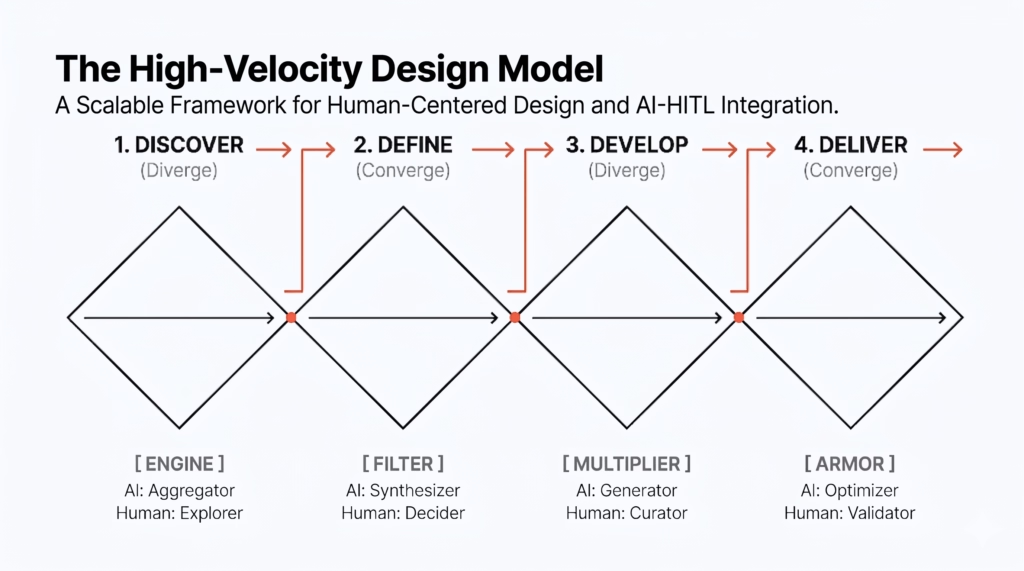
The answer is not to reject the machine, nor is it to surrender to it. The answer is The High-Velocity Design Model: a modern operational framework that expands the traditional process into a continuous, four-diamond lifecycle. By pairing high-performance AI engines with rigorous Human-in-the-Loop (HITL) validation at every milestone, this model enforces a strict rule: AI drives the velocity, but humans drive the direction.
This is how an expert team leverages technology as a force multiplier, shifting the creative bottleneck entirely from Production to Curation, and is the operational framework underlying Phoenixfire’s Brand Systems Engineering practice.
The Four Pillars of the High-Velocity Lifecycle
The traditional framework collapses four steps into two shapes. The High-Velocity Design Model separates them into four distinct diamonds, recognizing that an AI-enabled workflow treats every individual milestone as its own intense loop of expansion and critical narrowing.
Diamond 1: The Data Loop (Discover & Filter)
The lifecycle begins by diverging on the data landscape, utilizing computing power to aggregate information at scale.
The AI Lever [ENGINE — Aggregator]: Acts as an automated data aggregator. Instead of a junior planner manually scrolling through forums for 48 hours, thousands of lines of raw customer feedback, interview transcripts, and search trend datasets are fed into a controlled repository (like NotebookLM). The AI surfaces hidden, mathematical frequencies in language instantly.
The Human Checkpoint [ENGINE — Explorer]: Powered by Taste & Experience. AI can map semantic distances, but it doesn’t understand human context, cultural nuance, or why a participant’s voice cracked during an interview. The human strategist acts as the Explorer, filtering out algorithmic noise to capture genuine human friction.
Diamond 2: The Strategy Loop (Define & Lock)
Once the data is filtered, the process shifts to defining the precise business problem worth solving.
The AI Lever [FILTER — Synthesizer]: Functions as a structured synthesizer. By interacting with a customized, domain-specific AI agent trained explicitly on the brand’s core soul and operational guidelines, the team can rapidly simulate alternative positioning strategies and customer personas.
The Human Checkpoint [FILTER — Decider]: Powered by Discernment. AI cannot make a creative leap or a value judgment. The human consultant reviews the synthesized strategies, pushing back against trend-chasing concepts to lock down a high-utility direction that solves a real-world business challenge.
Diamond 3: The Production Loop (Develop & Curate)
With the strategic direction locked, the model enters the production loop. This is where the operational efficiency deviates entirely from a traditional agency.
The AI Lever [ MULTIPLIER ]: Functions as a hyper-speed generation engine. Instead of drafting a single layout at a time, the team prompts the structured AI infrastructure—using programmatic context models like [Time] [Form] [Place] [Event]—to instantly generate dozens of copy variations, structural wireframes, and raw asset scripts.
The Human Checkpoint [ CURATOR ]: Powered by Taste. The designer’s job completely transforms from a manual maker to an expert editor. The human curates the machine’s output, iteratively tweaking prompts, discarding variations that feel hollow, and selecting only the elements that match the brand’s authentic voice.
Diamond 4: The Validation Loop (Deliver & Armor)
The final diamond focuses on converting the curated concepts into finalized, optimized deliverables.
The AI Lever [ ARMOR ]: Operates as a technical optimizer—running code integrity checks, cross-platform aspect ratio rendering, automated layout matching, and distribution formatting.
The Human Checkpoint [ VALIDATOR ]: Serves as the Brand Armor. Because AI lacks conscious understanding, human oversight is the mandatory error-checking connective tissue. The human performs a rigorous line-by-line validation to verify factual integrity, cultural appropriateness, and structural safety before launch.
Operational Blueprint: Executing an Integrated Social Campaign
To see the true economic and creative power of this model, look at how it executes a comprehensive, multi-channel social media campaign for a premium heritage apparel brand client.
Step 1: Running Diamond 1 (The Data Loop)
Traditional Method: An agency team conducts secondary research, compiling generic customer personas (“Male, 30-45, loves the outdoors”) into a static PDF template over the course of a week.
High-Velocity Method: The agency uploads raw customer service data, focus group audio transcripts, and industry search text directly into their brand intelligence notebook. Within seconds, the AI aggregator notes an underlying emotional anxiety: the target audience isn’t just looking for “vintage clothing”—they are deeply frustrated by “disposable fast fashion” and hollow “influencer bait”. The human explorer immediately isolates this tension, selecting “generational longevity” as the campaign’s emotional anchor.
Step 2: Running Diamond 2 (The Strategy Loop)
Traditional Method: The team sits in a two-hour brainstorming meeting. The loudest voice in the room wins, usually resulting in a trendy concept that chases current algorithm behaviors but dilutes the brand’s premium identity.
High-Velocity Method: The strategist prompts their tailored “Strategic Creative Director” agent. The agent is programmed with a stoic, direct persona and is explicitly commanded to reject corporate buzzwords or fast-fashion marketing traps. The AI maps out five distinct conceptual angles based on the data loop. The human decider analyzes the options and locks onto a multi-part series titled “The Testimony of Wear”—focusing on real, weathered grit over showroom perfection.
Step 3: Running Diamond 3 (The Production Loop)
Traditional Method: Copywriters spend days drafting captions. Designers search stock photo sites for hours, settling for polished images that look obvious, corporate, and fake.
High-Velocity Method: The AI creative director instantly generates five distinct caption structures written in the brand’s exact voice. Concurrently, it outputs precise generative image prompts mapped to the [Time] [Form] [Place] [Event] matrix. The human designer inputs these structured scripts into a generative visualization engine (like Midjourney). Shifting the bottleneck to curation, the designer rapidly cycles through variations, editing prompts to introduce cinematic, raw textures (e.g., 1920s Lomography medium shot of a rider in a heavy, windburned black leather jacket outside an industrial brick workshop).
Step 4: Running Diamond 4 (The Validation Loop)
Traditional Method: A hurried account director skims the final links on a phone screen an hour before deployment, checking for typos but lacking the time to verify structural cohesion across platforms.
High-Velocity Method: The AI optimizer formats the chosen visual assets for Instagram, LinkedIn, and YouTube Shorts seamlessly, tagging accessibility data automatically. The human validator steps in as the brand’s armor, reviewing every image artifact and line of copy. They verify that the textual content contains no hallucinations, ensure the generated graphics maintain absolute historical accuracy, and approve the assets for market.
Why the High-Velocity Model Outperforms Traditional Frameworks
| Operational Vector | The Traditional Agency Process | The High-Velocity Design Model |
| Primary Economic Currency | Billable Hours: Clients pay for manual production time (typing, template editing, image searching). | Intellectual Equity: Clients pay exclusively for human strategy, taste, critical discernment, and curation. |
| Production Bottleneck | Execution: The process slows to a crawl during the manual generation of copies, wireframes, and layouts. | Editing: Assets are generated instantly; the bottleneck moves to refining, filtering, and checking quality. |
| Scale Mechanism | Linear Cost: Scaling volume requires hiring more manual labor, increasing overhead and production timelines. | Exponential Leverage: A single expert scales their taste across hundreds of variations instantly using an automated engine. |
| Risk Management | Reactive QC: Human error increases with creative fatigue right before a compressed campaign deadline. | Proactive [ ARMOR ]: Explicitly treats AI as an unguided liability, building systemic human verification into every phase. |
Curate, Not Automate
The ultimate advantage of The High-Velocity Design Model is that it scales output without diluting the soul of the work. It acknowledges an undeniable reality of the modern market: authenticity cannot be completely automated, but it can be accelerated.
By organizing your creative ecosystem into a loop-validated, four-diamond lifecycle, you eliminate the friction of low-value manual labor. Your teams stop spending their energy simply trying to create mass volume, allowing them to focus entirely on what truly moves the needle: strategic synthesis, deep human empathy, and uncompromising creative excellence.
